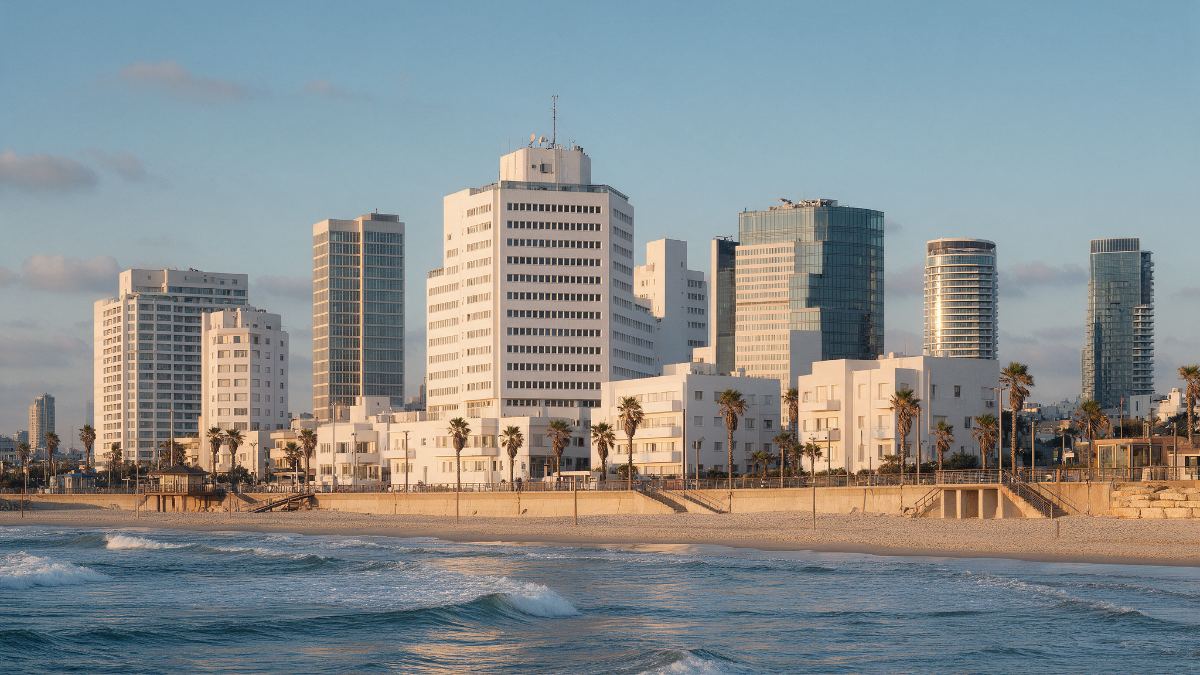
Buying property in Tel Aviv: 2026 prices, neighborhoods, advice
Tel Aviv is Israel’s most expensive market and one of the priciest on the Mediterranean: ₪4.59M on average per apartment, and up to ₪90,000 per m² on the seafront. It is also the most technical market in the country: old buildings never registered as condominiums, TAMA 38, Church and waqf land in Jaffa, parking sold separately. This guide gives real price ranges by neighborhood, what is being built, the city-specific traps, and how to buy depending on your status.
Tel Aviv in four figures
₪4.59M average price per apartment (CBS, Q1 2026), about $1.27M, +10.3% in a year; ₪45,000 to ₪90,000 per m² by neighborhood (ranges observed on Madlan and Yad2, Q3 2026); about 480,000 residents and close to half of the country’s tech jobs; 2.3 to 3% gross rental yield, the lowest in Israel. A market of scarcity, driven by affluent local buyers, foreign investors and pied-à-terre demand, where new stock comes almost entirely from urban renewal.
The figures to remember, November 2026
- Average apartment price
- ₪4.59M
- One-year change (CBS, Q1 2026)
- +10.3%
- Price per m² by neighborhood
- ₪45–90k
- Gross rental yield
- 2.3–3%
- Purchase tax, non-resident, on ₪5.5M
- ₪440,000
- Purchase tax, resident only home, on ₪5.5M
- ₪170,538
Prices by neighborhood (observed ranges, Q3 2026)
| Neighborhood | ₪/m² observed | Profile |
|---|---|---|
| Neve Tzedek, Rothschild Boulevard, Park Tzameret | 70,000–90,000 | The top of the market: restored houses in Neve Tzedek, Bauhaus buildings on Rothschild, Park Tzameret towers with pool and concierge. Many foreign buyers and second homes. |
| Old North (Tzafon HaYashan), Bavli | 55,000–70,000 | Classic residential Tel Aviv between Dizengoff, Ben Yehuda and the Yarkon: 1930s-70s buildings, lots of TAMA 38, quiet streets five minutes from the beach. Bavli, newer, around the park. |
| Ramat Aviv, Ramat Aviv Gimel, Kochav HaTzafon | 50,000–65,000 | North of the Yarkon, near the university: families, 1990s-2010s towers, large apartments with parking. Kochav HaTzafon, closer to the sea, at the top of the band. |
| City center, Lev HaIr, Kerem HaTeimanim | 55,000–75,000 | Around the Carmel market, Allenby and Dizengoff Square: small apartments, strong rental demand, heavy renovations common. |
| Florentin, Shapira, Kiryat Shalom | 45,000–55,000 | The south in renewal: converted workshops, pinui-binui sites under way, young population. The city’s entry price inside the historic core. |
| Jaffa (Yafo), Ajami, Givat Aliya, Noga | 40,000–60,000 | The widest spread in the city: Ottoman houses and the seafront at 60,000, Amidar buildings or Church and waqf land at 40,000. The title makes the price. |
| Yad Eliyahu, Hatikva, Neve Shaanan | 38,000–48,000 | East and south-east along the light rail Red Line: budgets under ₪3M for a 3-room, many urban renewal projects. |
In Israel the price per m² is quoted on gross area (walls included, often the balcony and a share of the common areas): a listing at 90 m² corresponds to 72-77 m² of usable space in the US or UK sense, about 775-830 sq ft. In the Park Tzameret or Bavli towers the share of common areas (lobby, pool, gym) can reach 10 to 12% of the billed area (see gross vs net square meters). Tel Aviv against the other cities: Israel real estate prices city by city.
Who buys in Tel Aviv, and why
The Tel Aviv market splits into four profiles. Affluent local buyers first: tech executives, professionals, families trading up, concentrated in the Old North, Bavli and Ramat Aviv. Foreign buyers next, American, French, British, who buy a 2-3 room pied-à-terre near the sea (Old North, Neve Tzedek, Kerem HaTeimanim) and rent it out between visits. Investors, who target small apartments in the center and the south for yearly lets, accepting 2.3 to 3% gross in exchange for liquidity and long-term growth no other city offers. Future olim last, often young and working in tech, who buy in Florentin, Yad Eliyahu or Jaffa, where a 3-room still sits under ₪3.5M.
For an English-speaking buyer, Tel Aviv has no "Anglo neighborhood" the way Jerusalem or Raanana do: the community is spread out, more visible in the Old North, around Rothschild and in Neve Tzedek, with English-speaking minyanim in the center and the north. The choice is therefore about the unit, the street and the building more than the community. What aliyah changes in the plan: 75% financing instead of 50%, and a purchase tax divided by twenty (see buying as a new immigrant). American buyers should also read buying property in Israel from the USA for the FATCA and dollar side; British buyers, buying from the UK.
Towers, TAMA 38 and pinui-binui: where the new stock comes from
Tel Aviv has almost no free land left. New stock comes from three sources. Towers on the last large plots: Park Tzameret, Sde Dov in the north (the former airport, several thousand homes being delivered between 2026 and 2030), the HaHagana station and Hatikva area in the south-east. TAMA 38 (the national seismic reinforcement plan): either TAMA 38/1, adding 2-3 floors to an existing building, or TAMA 38/2, demolish and rebuild; the Old North and the center have hundreds of them, and the scheme, extended several times, is gradually giving way to municipal densification plans. Pinui-binui (demolition and rebuilding of whole blocks, with the occupants rehoused): Yad Eliyahu, Neve Shaanan, Kiryat Shalom, Shapira, Jaffa Daled.
For the off-plan buyer the rules are those of the Sale Law: bank guarantee on every instalment, balance indexed to the construction cost index (madad tshumot habniya), 20/80 schedules common, usual delays of 6 to 12 months with penalties due beyond 60 days. Three Tel Aviv particularities: TAMA 38 developers are often mid-sized, which makes the bank guarantee essential; an apartment from urban renewal costs 10 to 20% less than a conventional new build in the same neighborhood; and parking, in a city short of it, is worth ₪250,000 to ₪450,000 per space. The full mechanism is in buying off-plan from a developer, and the new vs resale comparison in new-build or second-hand.
The light rail is redrawing the map. The Red Line (Bat Yam – Jaffa – Allenby – central station – Petah Tikva) has run since 2023; the Purple and Green lines are under construction. The southern and eastern neighborhoods it serves (Jaffa, Florentin, Neve Shaanan, Yad Eliyahu) have closed part of the gap with the center, and the works still weigh on some streets. Check the route and the timetable before buying on an avenue under construction.
Points of vigilance specific to Tel Aviv
No other city stacks up as many unusual legal situations. The lawyer must check them before the heskem mechira (sale contract) is signed, and they weigh on the price as much as the view does.
- Old buildings never registered as condominiums. Hundreds of 1930s-60s buildings in the center and the south are not registered as a bayit meshutaf (condominium) at the Tabu (land registry): you buy an undivided share of the plot (musha) with an exclusive-use agreement, not a unit. Mortgages are harder, resale too. Ask for the nesach Tabu (registry extract) and, if there are no units, a written opinion on the registration procedure and its cost.
- Parking and storage sold separately. In Tel Aviv a parking space is often a separate unit or a common area attached to the apartment (hatzmada); it must appear in the contract and at the Tabu. A "use" space promised by the seller with no attachment is worth nothing at resale.
- Jaffa: Church, waqf, Amidar. Parts of Ajami, the Old City and Givat Aliya are built on land of the Greek Orthodox Church or of a waqf (Muslim religious endowment) under long leases, or belong to the public housing company Amidar. Leases end, are renewed or not, and condition the mortgage; some properties are not at the Tabu but with the housing company. The price can be 30% below a freehold property: that is the risk, priced in.
- TAMA 38 under way or promised. A building "with a signed TAMA 38 project" is worth more; but a signed project is neither a permit nor a construction site. Check the status at the municipality and the developer’s strength, and read what the agreement imposes on the owners (works, rehousing, timelines).
- Short-term rentals. Higher arnona (municipal tax) for homes let short-term, bans in building by-laws and the national regulation under discussion make the "Airbnb" model less and less reliable as a basis for the numbers. Buy on the yearly rental value.
- Zikaron dvarim. In Tel Aviv sellers often push to sign a zikaron dvarim (preliminary agreement) at the first viewing. It is legally binding. Sign nothing before the lawyer has read the nesach Tabu.
These checks, their cost and the fees charged in the city are detailed in real estate lawyer in Tel Aviv. If you are buying from abroad, the power of attorney and the flow of funds are in buying property in Israel from abroad.
Buying in Tel Aviv by status
Resident, only home
tax 0 → 5%- Financing up to 75%.
- On ₪5.5M: purchase tax ₪170,538.
- Loan up to ₪4,125,000, payment ≈ ₪23,400 over 25 years.
Non-resident
tax 8%- Financing 50% as a rule.
- On ₪5.5M: purchase tax ₪440,000.
- Cash required ≈ ₪3.4M including fees.
New immigrant (oleh)
tax ≈ 0.3%- Financing up to 75%.
- On ₪5.5M: purchase tax ₪17,606.
- Saving of ₪422,394 compared with a non-resident.
Tel Aviv is where status weighs most in absolute terms: at ₪5.5M the tax gap between a non-resident and a resident buying their only home exceeds ₪269,000, and the 10% threshold (₪6,055,070) is quickly reached on a new 4-room. A non-resident who becomes a tax resident within two years of the purchase is reclassified as "only home" and recovers the difference; an oleh gets the reduced scale from one year before to seven years after aliyah. The detail is in mas rechisha 2026 and in purchase tax for foreigners.
Breakdown by bracket
| Bracket | Rate | Tax |
|---|
Brackets of 16 January 2025, frozen until 15 January 2028 (Arrangements Law). A non-resident is taxed as an additional-home buyer unless they become an Israeli resident within two years of the purchase. Payment is due within 60 days of signing.
Full budget: a 4-room apartment in the Old North
| Price | ₪5,500,000 |
| Purchase tax (8%) | ₪440,000 |
| Lawyer (0.5 to 1% + 18% VAT) | ≈ ₪48,000 |
| Agency (2% + VAT) | ≈ ₪130,000 |
| Mortgage broker, appraisal (shamai), bank fees, insurance | ≈ ₪22,000 |
| Translations, power of attorney, apostille, wires | ≈ ₪6,000 |
| Total cost | ≈ ₪6,146,000 (+ 11.7%) |
| Mortgage at 50% | ₪2,750,000 → ≈ ₪15,600 / month over 25 years |
| Cash to plan for | ≈ ₪3,396,000 (≈ $945,000 / £740,000) |
The same apartment on a yearly lease brings ₪11,000 to ₪13,000 a month, 2.4 to 2.8% gross: the mortgage payment exceeds the rent. That is the rule in Tel Aviv, and it is why the banks look first at your income abroad, not at the expected rent. Unlike a US closing there is no title insurance, no escrow fee and no transfer tax beyond the purchase tax. Run your own numbers in the Israeli mortgage calculator; each line item is explained in closing costs in Israel, and the mortgage (mashkanta) for a buyer abroad, its documents and timelines, in mortgages for non-residents.
Professionals on the ground
Tel Aviv has the most specialised real estate law firms in the country, used to unregistered buildings, TAMA 38 and non-resident files, agencies that work in English in the Old North, Neve Tzedek and around Rothschild, mortgage brokers used to incomes in dollars or pounds, and the large developers behind the Sde Dov and southern towers. We select them on three criteria: real estate specialisation, independence from sellers, and experience with remote purchases. Before handing over a file, read how to choose your real estate lawyer and how to buy property in Israel, step by step.
Nearby: Herzliya for the Pituach villas and the marina, Raanana for a family city with a large Anglo community 25 minutes away, Netanya for new builds facing the sea at half the price, Jerusalem for the largest Anglo community in the country.
Frequently asked questions
What is the average price of an apartment in Tel Aviv in 2026?
₪4.59 million (≈ $1.27M) according to the Central Bureau of Statistics (Q1 2026), up 10.3% in a year and double the national average (₪2.33M). A resale 3-room apartment in the Old North trades between ₪3.8M and ₪5M; a new 4-room on Rothschild or in Park Tzameret is above ₪8M.
What are Tel Aviv real estate prices per square meter?
Between ₪45,000 and ₪90,000 per gross m² depending on the neighborhood and condition, based on ranges observed on Madlan and Yad2 in Q3 2026: ₪45-55k in Florentin and Shapira, ₪55-70k in the Old North and Bavli, ₪70-90k in Neve Tzedek, on Rothschild and in Park Tzameret. Jaffa runs from ₪40k to ₪60k depending on the street and the title. ₪10,000 per m² is roughly $258 per sq ft.
Can a foreigner buy an apartment in Tel Aviv?
Yes, with no nationality restriction. What changes: a flat 8% purchase tax (10% above ₪6,055,070) instead of the residents’ progressive scale, bank financing capped at 50% of the price in practice, and a power of attorney if you do not fly in to sign. On ₪5.5M the tax alone is ₪440,000.
Can I rent out my Tel Aviv apartment short-term (Airbnb)?
Less and less freely. The municipality charges a higher arnona (municipal tax) on homes let short-term, a growing number of building by-laws forbid it, and national regulation is under discussion. Before buying for that model, have the lawyer check the building’s by-laws (takanon) and the house committee’s decisions.
Is TAMA 38 a good deal in Tel Aviv?
Often, provided you know what you are buying. A new apartment from a TAMA 38/2 (demolish and rebuild) costs 10 to 20% less than a conventional new build in the same neighborhood, with a safe room, elevator and parking. The trade-off: 3 to 5 year timelines, mid-sized developers, and a price that depends on the existing owners’ agreement. The Sale Law protects every instalment.
What rental yield can I expect in Tel Aviv?
Between 2.3 and 3% gross on a yearly lease, the lowest in the country: rents have not kept pace with prices. A 3-room at ₪4.5M rents for ₪9,000 to ₪11,000 a month. The case is capital (scarcity, liquidity, long-term growth) rather than income.
How we work
Every amount, bracket and rate on this page is checked against the official source listed at the bottom and dated. When a schedule or rate changes, the page is updated within days. Our methodology.
Sources
- Central Bureau of Statistics – average home prices by city, Q1 2026
- Madlan – price per m² by neighborhood in Tel Aviv-Jaffa (observed ranges, Q3 2026)
- Yad2 – apartments for sale in Tel Aviv-Jaffa (observed ranges, Q3 2026)
- Israel Tax Authority – purchase tax (mas rechisha) brackets 2026
- Tel Aviv-Jaffa Municipality – planning, urban renewal, arnona
- Bank of Israel – current rates
Your Tel Aviv project, with the right people
Agency, lawyer, mortgage broker or developer: tell us the neighborhood, budget and timeline, and we pass it to an English-speaking professional who works Tel Aviv every day.