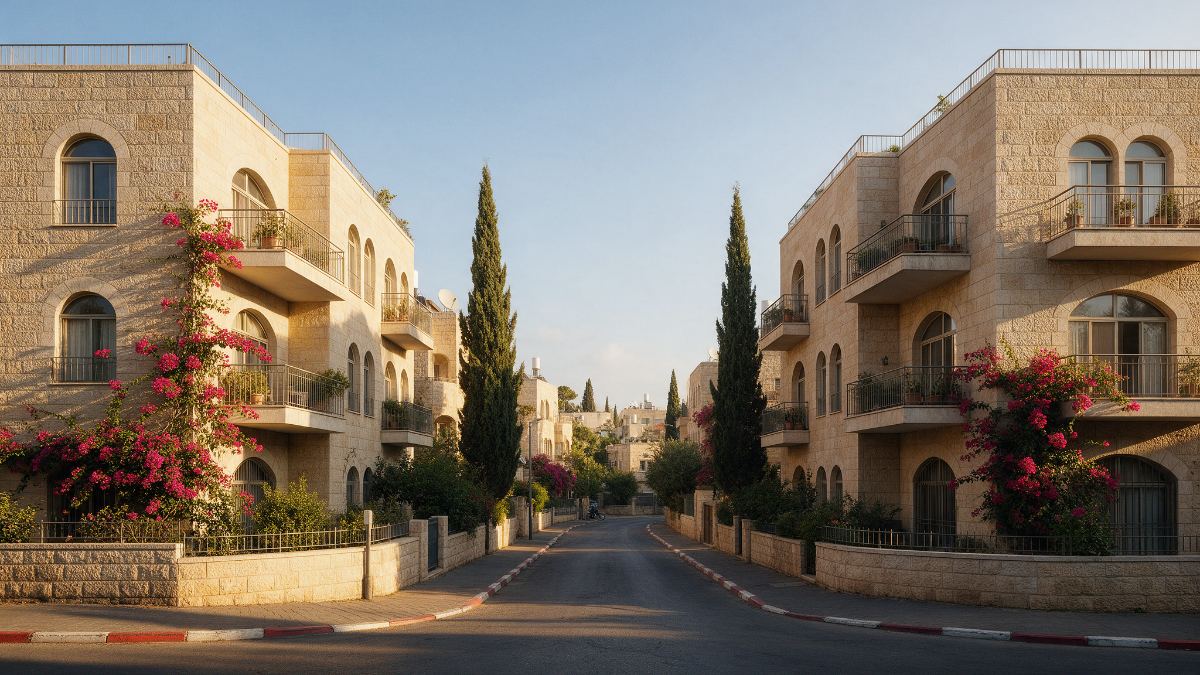
Buying in Baka (Jerusalem): 2026 prices, properties, due diligence
Baka is the neighbourhood where a French- or English-speaking buyer finds, within ten minutes on foot, their synagogue, their children’s school, their bakery and neighbours from Paris, London or New Jersey. Between Derech Hevron and the old railway park, high-ceilinged Arab houses sit next to renovated 1950s–70s buildings and a few new projects. Prices, property types, who buys, and what a lawyer checks here on top of the usual.
The short answer
In Baka, resale trades between ₪42,000 and ₪55,000 per m² in 2026 and new builds between ₪55,000 and ₪70,000: a 3-room, 80 m² apartment is worth ₪3.4–4.2M, a 4-room, 100 m² apartment ₪4.2–5.5M (≈ $1.17–1.53M), an Arab-house apartment with garden ₪6–10M. On a 4-room unit at ₪4.6M a non-resident pays 368,000 ₪ in purchase tax (mas rechisha), a resident buying their only home 125,538 ₪, an oleh 13,106 ₪. Jerusalem’s olim family neighbourhood, 25 minutes on foot from the Old City and five from the light rail on Derech Hevron. What needs care here: the heritage listing of the old houses, unpermitted additions accumulated since 1950, and parking.
The figures to remember, November 2026
- ₪/m² resale
- 42,000–55,000
- ₪/m² new / added floor
- 55,000–70,000
- 4 rooms, 100 m² gross
- ₪4.2–5.5M
- Parking space in a recent project
- ₪150,000–250,000
- Purchase tax, non-resident, on ₪4.6M
- 368,000 ₪
- Gross rental yield
- 2.8–3.2%
The neighbourhood: Baka
Baka (officially Geulim in Hebrew, a name nobody uses) stretches south of the German Colony, between Derech Hevron to the east, the railway park (Mesilat HaRakevet, the old Ottoman line turned into a promenade) to the west, and Talpiot to the south. Its arteries: Derech Beit Lechem, the shopping street with its cafés and grocers, and Yehuda, Rivka, Reuven, Shimshon, Gideon and Esther HaMalka streets. The neighbourhood was built in the 1920s–40s by well-off Arab families, then densified after 1948 with three- and four-storey stone buildings for new immigrants; since the 1990s both layers have been renovated apartment by apartment.
Distances: the Old City (Jaffa Gate) 25 minutes on foot or ten by light rail from the Derech Hevron stop; the First Station (Tachana Rishona), with restaurants and a market, at the neighbourhood’s northern corner; Emek Refaim five minutes away. Community life is the main asset: a dozen synagogues in and around the neighbourhood, including several French-speaking ones, Kehilat Yedidya and other English-speaking minyanim, religious and secular state schools with many olim children, and shops that run in French and English on Friday mornings.
Property types and prices by size
| Property | Gross area | 2026 price | What to know |
|---|---|---|---|
| 2 rooms, 1950s–70s building | 50–60 m² | ₪2.2–2.8M | Pied-à-terre or investment; no elevator or parking. |
| 3 rooms, renovated 1950s–70s building | 75–85 m² | ₪3.4–4.2M | The product young olim couples ask for most. |
| 4 rooms, renovated building with elevator | 95–110 m² | ₪4.2–5.5M | Families; check the safe room, parking and garden share. |
| 4–5 rooms, new project or TAMA 38 added floor | 110–140 m² | ₪6–9M | Elevator, parking, safe room, terrace; ₪55,000–70,000 per m². |
| Arab-house apartment with garden | 100–180 m² + garden | ₪6–10M | High ceilings, stone, often listed; title and additions to check. |
| Whole Arab house | 200–350 m² | ₪12–20M | Rare; diaspora buyers, usually needs renovation. |
Price per m² is quoted on gross area: a 4-room apartment listed at 100 m² offers 80 to 85 m² of living space, about 860–915 sq ft (see gross vs net square meters). In Arab houses the gross area includes 50–70 cm walls, so the gap is even wider.
Who buys in Baka
Three profiles. Olim families, French and Anglo, the neighbourhood’s main driver for twenty years: they buy a 3–4 room apartment between ₪3.4M and ₪5.5M, often after a year or two of renting locally, financed at 75% at the 0.5% oleh tax rate. Diaspora buyers (US, UK, France, Belgium, Switzerland) who want a base in a lively neighbourhood rather than Rechavia, and who account for part of the dirot refaim (apartments occupied a few weeks a year) that the municipality has taxed more heavily since 2024. Israelis, finally, secular and religious, drawn by the park, the cafés of Derech Beit Lechem and the schools; they give the neighbourhood its mix and its resale depth.
Gross yield is modest, 2.8 to 3.2%, but olim rental demand is constant: an investor who buys a renovated 3-room unit lets it within days to an olim family or a couple waiting for a new-build delivery in Arnona.
Worked example: a 4-room apartment bought by a non-resident
| Price | ₪4,600,000 |
| Purchase tax, non-resident (8%) | 368,000 ₪ |
| Lawyer (0.5 to 1% + VAT) | ≈ ₪40,000 |
| Agency (2% + VAT) | ≈ ₪108,500 |
| Mortgage broker, appraisal, bank fees, insurance | ≈ ₪22,000 |
| Translations, power of attorney, apostille, wires | ≈ ₪6,000 |
| Total cost | ≈ ₪5,144,500 (+ 11.8%) |
| Mortgage at 50% | ₪2,300,000 → ≈ ₪13,000 / month over 25 years |
| Cash to plan for | ≈ ₪2,844,500 (≈ $790,000 / £620,000) |
The same apartment bought by a resident as their only home would carry 125,538 ₪ in tax; by an oleh hadash, 13,106 ₪. A non-resident who makes aliyah within two years of the purchase can claim the difference back. Unlike a US closing, there is no title insurance, escrow fee or transfer tax beyond this. The schedule is in mas rechisha 2026, 50% financing in mortgages for non-residents, and the US-specific steps in buying property in Israel from the USA.
Neighbourhood-specific due diligence: preservation, additions, parking
- Heritage listing. The municipality adopted a preservation plan for Baka and the German Colony that protects pre-1948 houses and part of the 1950s buildings: stone façades, tiled roofs, boundary walls, sometimes gardens. Before buying an Arab house to renovate or extend, ask the planning department for the listing grade and the real building rights.
- Unpermitted additions. Seventy years of enclosed balconies, rooftop rooms, converted basements and houses split into apartments. The lawyer compares the permit (heter bniya) and the filed plans with what stands; an unregularised addition can mean a fine, a demolition order, a bank refusal and trouble reselling. Regularisation at the seller’s expense, or a price cut, written into the contract.
- Gardens and common areas. In split houses, the garden "attached" to an apartment is often just tolerated use, not registered at the Tabu. Check the building by-laws (takanon) and the division plan; without registration, the garden is not yours.
- Parking. Pre-1990 buildings have none; streets are in regulated residential parking. A space in a recent project sells for ₪150,000–250,000 and must be registered on your unit, not "allocated" verbally.
- Chain of title on absentee property. Many Baka houses were absentee property managed by the State after 1948, then sold. The lawyer checks that the chain of transfers down to the current seller is complete and registered.
- No zikaron dvarim without a lawyer. The pre-agreement is binding. Fees and the city-specific checks are in real estate lawyer in Jerusalem.
Renting out in Baka: long or short term
Long term, a renovated 3-room apartment rents for ₪7,000–8,500 a month, a 4-room for ₪9,000–12,000, a gross yield of 2.8 to 3.2%. Demand comes from olim families waiting to buy, young couples, gap-year and yeshiva students, and hospital staff. Short term, the municipality does not ban holiday lets, but the building by-laws may exclude them, arnona may switch to a non-residential rate and the income falls under the real tax regime rather than the 10% flat rate; in a residential neighbourhood like Baka, neighbours tolerate turnover poorly. Rental tax rules for an owner living abroad are detailed on shekelguide.com.
Frequently asked questions
What is the price per square metre in Baka in 2026?
Between ₪42,000 and ₪55,000 per m² for resale, depending on condition, elevator and parking, and ₪55,000 to ₪70,000 in new projects and recent added floors, according to Madlan listings and declared transactions. That is roughly $1,080–1,420 per sq ft for resale. Arab houses and house apartments with a garden often exceed ₪60,000 per m². Southern Baka, towards Talpiot and Derech Hevron, is 10 to 15% cheaper than the north, towards the German Colony.
Why is Baka known as an olim neighbourhood?
Because the French community settled there from the 1990s–2000s and the Anglo community alongside it, around a dozen synagogues (French-speaking Sephardi and Ashkenazi congregations, Kehilat Yedidya and other English-speaking minyanim), schools with many olim children, and shops run by immigrants. A buyer finds a rabbi, a doctor, a lawyer and an agent who speak their language, which explains steady demand and prices above Katamon or Arnona for equal quality.
What is an Arab house in Baka, and what are the precautions?
A house built between 1920 and 1948 by Christian and Muslim Arab families, in stone, with 4-metre ceilings, painted tile floors and a garden, often split into two to four apartments after 1948 and managed as absentee property transferred to the State and later sold. Precautions: check the chain of title at the Tabu, the heritage listing, the allocation of common areas and garden between units, and the additions made without permits over the decades.
Can you park in Baka?
With difficulty. Pre-1990 buildings have no parking, and the streets are in a residential parking zone, paid for non-residents. A space in a recent project sells for ₪150,000–250,000. The railway park and the light rail (Red Line on Derech Hevron, extensions under way) make a car less necessary, but a buyer who has one must settle the question before signing.
How we work
Every amount, bracket and rate on this page is checked against the official source listed at the bottom and dated. When a schedule or rate changes, the page is updated within days. Our methodology.
Sources
A property in Baka?
Agency, lawyer or broker: tell us the street or sector, the size you are after and your status (resident, non-resident, aliyah planned). We pass it to an English-speaking professional who works Baka every day.